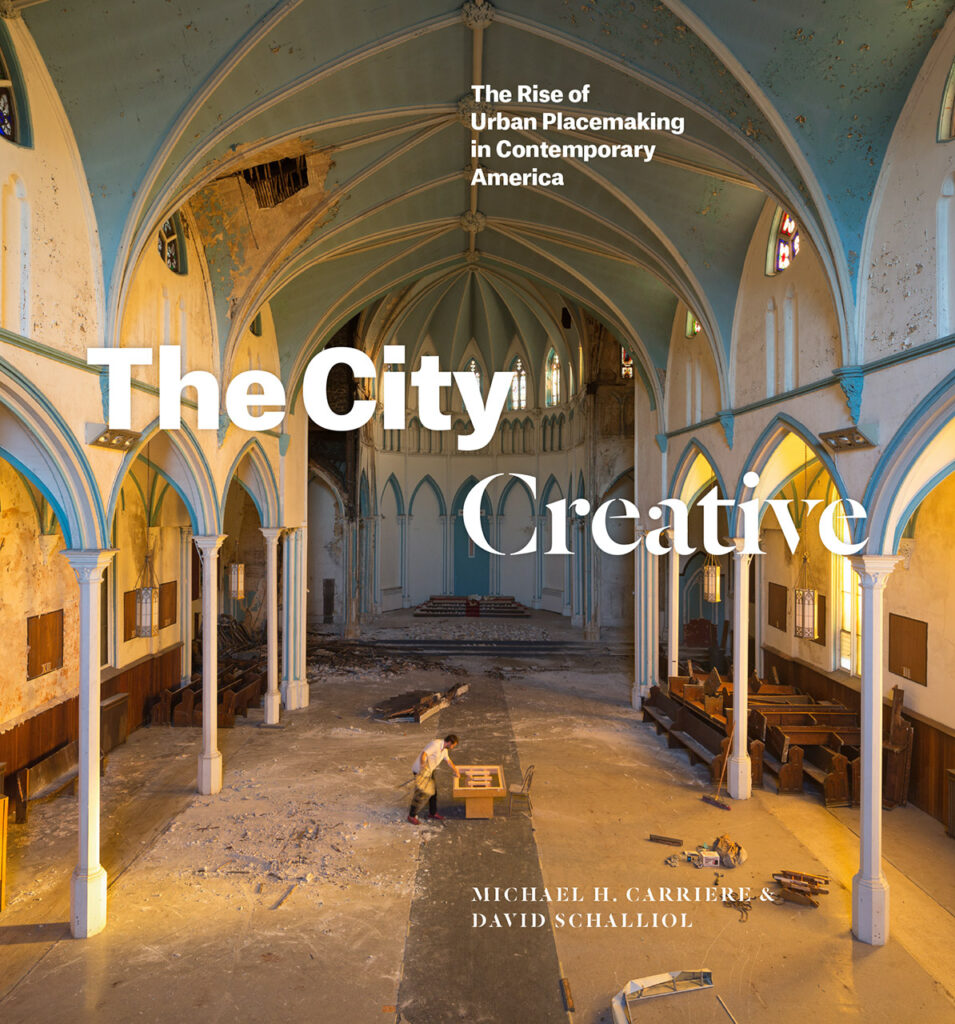
I am thrilled to announce that my new book with Michael Carriere, The City Creative: The Rise of Urban Placemaking in Contemporary America, was published by The University of Chicago Press in April 2021. Michael and I started working on this long-term study in the immediate aftermath of the Great Recession, and so it seems fitting that it is being published as people are learning how to re-create cities amongst the ongoing COVID crisis.
As described by The University of Chicago Press:
In the wake of the Great Recession, American cities from Philadelphia to San Diego saw an upsurge in hyperlocal placemaking—small-scale interventions aimed at encouraging greater equity and community engagement in growth and renewal. But the projects that were the most successful at achieving these lofty ambitions weren’t usually established by politicians, urban planners, or real estate developers; they were initiated by community activists, artists, and neighbors. In order to figure out why, The City Creative mounts a comprehensive study of placemaking in urban America, tracing its intellectual history and contrasting it with the efforts of people making positive change in their communities today.
Spanning the 1950s to the post-recession 2010s, The City Creative highlights the roles of such prominent individuals and organizations as Jane Jacobs, Christopher Alexander, Richard Sennett, Project for Public Spaces, and the National Endowment for the Arts in the development of urban placemaking, both in the abstract and on the ground. But that’s only half the story. Bringing the narrative to the present, Michael H. Carriere and David Schalliol also detail placemaking interventions at more than 200 sites in more than 40 cities, combining archival research, interviews, participant observation, and Schalliol’s powerful documentary photography. Carriere and Schalliol find that while these formal and informal placemaking interventions can bridge local community development and regional economic plans, more often than not, they push the boundaries of mainstream placemaking. Rather than simply stressing sociability or market-driven economic development, these initiatives offer an alternative model of community-led progress with the potential to redistribute valuable resources while producing tangible and intangible benefits for their communities. The City Creative provides a kaleidoscopic overview of how these initiatives grow, and sometimes collapse, illustrating the centrality of placemaking in the evolution of the American city and how it can be reoriented to meet demands for a more equitable future.
You can see more about the book on my main website and purchase it through bookstores everywhere, like the independent Milwaukee community space Lion’s Tooth.
Financial support for The City Creative was provided by the Graham Foundation for Advanced Studies in the Fine Arts.
Leave a Reply